From Kohl to the Compact: A Brief History of Eyeliner
Eyeliner history traces how kohl, pencils and liquid formulas changed eye outlining, revealing how materials, tools and habits shaped each form.
Why did eyeliner history move from dark powder in a vessel to a pencil carried in a handbag? Eyeliner history is a story of changing materials and tools, but not a single, universal progression. Kohl, wax pencils and liquid liners each shaped a different way to define the eye, while their meanings depended on the people and settings in which they were used.
What did early eye outlining involve?
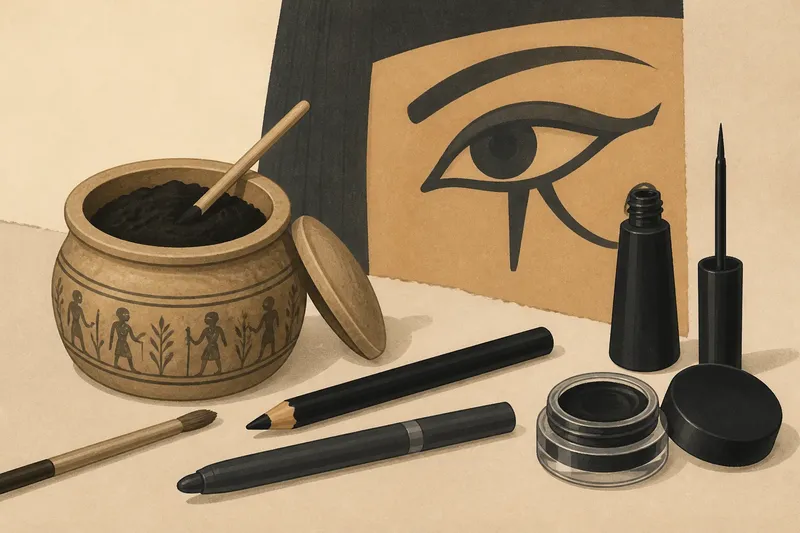
In ancient Egypt, people used dark preparations around the eyes. Modern writing often calls these preparations kohl, but the label covers varied materials and practices; it should not be treated as the name of one fixed recipe. Some surviving ancient Egyptian eye cosmetics contain lead-based minerals such as galena. Other substances and mixtures also appear in historical accounts, so the ingredients cannot be reduced to a single formula.
Small applicators helped transfer powder from a container to the eye. The outline could frame the eye and contribute to a finished appearance, but its purpose should not automatically be equated with modern cosmetic eyeliner. The evidence for any particular use belongs to its specific place and period. Dark eye preparations could be part of adornment, while some historical contexts also associated them with protection or ritual; those associations were not universal and should not be projected onto every wearer or culture.
A familiar-looking dark line, then, does not tell us everything about why it was worn. The material, object and local practice matter as much as the appearance.
How did powder and applicators shape the look?
Powder required a separate tool. A slender stick or other small applicator could pick up material from a vessel and place it along the eye. The user adjusted the mark through the amount of powder, the angle of the tool and the pressure of the hand. It was a sequence of loading and placing, rather than the direct glide of a pencil.
The container was part of the practice, too. It held the material between uses; the applicator connected that stored powder to the eye. Together, these objects show why eyeliner history is not just a tale of changing pigments. It also concerns the gestures that a tool makes possible.
Depending on the powder and its application, the outline could appear soft or more pronounced. Unlike a pencil, it did not arrive as a ready-made line. The user had to gather, place and adjust it.
Why did eyeliner take on different meanings?
Eye outlining has appeared in different communities and periods, but a similar shape does not prove a shared meaning. It might contribute to adornment in one setting, while surviving evidence in another points to ritual or protective associations. Such interpretations need to stay tied to their particular context rather than being treated as a universal explanation.
Later cosmetic fashions increasingly presented eyeliner as a way to shape an expressive face. That is one strand of its history, not a meaning that can be applied to every earlier practice. Materials, customs and ideas about appearance all help explain how a line around the eye was understood.
When looking at an old image or object, ask what evidence supports an interpretation before assigning a purpose.
What changed with pencils, liquids and creams?
As cosmetic products became available in manufactured, portable formats, eye colour could be carried in forms that did not require a separate powder pot and applicator. A pencil enclosed pigment in a waxy or creamy core and drew directly on the skin. Its edge could be softened by blending, depending on the formula.
Liquid eyeliner offered another kind of mark. A fine brush or applicator delivered a wet line that could dry into a crisp shape. Cream and gel products, often applied from a pot with a brush, allowed the user to build a line through controlled strokes. These formats encouraged different movements; none simply erased the others.
Say you are choosing a tool for a soft outline rather than a sharp wing. A blendable pencil can be drawn near the lashes and gently blurred, leaving a softer border than a fine liquid tip would usually create. The result depends on the product and the hand, but the choice of format sets the starting point.
How do eyeliner tools change the result?
- Powder and applicator: Check whether you want a line built through loading and placement; if you do, choose a powder format, but if you want a direct stroke, choose a pencil instead.
- Wooden pencil: Check whether you want a drawn line that can be softened; if so, use a blendable pencil, but if you need a very crisp edge, choose a fine liquid applicator.
- Retractable pencil: Check whether avoiding a separate sharpener matters to your routine; if it does, choose a retractable format, but if you prefer a freshly pointed tip, choose a sharpenable pencil.
- Liquid liner: Check whether a crisp, defined line is the goal; if it is, use a fine liquid tip, but if you want a softer border, choose pencil or powder.
- Gel or cream in a pot: Check whether you are comfortable using a brush; if you are, choose a pot for brush-led strokes, but if you want to draw directly without loading a tool, choose a pencil.
- Container and applicator: Check whether the product needs a separate tool or careful handling; if it does, keep its components together, but if you want fewer loose items, choose a self-contained pencil format.
Imagine a reader has a powder pot, a small brush and a preference for a smoky outline, but needs to apply makeup while travelling. They decide the separate pot and brush are awkward to carry, choose a soft pencil instead, and draw a short line that they blur with a fingertip. The expected trade-off is a more convenient, direct application, but a different texture and gesture from working with powder.
What do readers ask about eyeliner history?
Is kohl the same as modern eyeliner?
No. Kohl is a broad modern label for traditional eye-darkening preparations, while modern eyeliner includes manufactured pencils, liquids, gels and other forms. The ingredients, handling and cultural contexts can differ.
Why were small applicators used?
A small applicator carried powder from its vessel to the eye and helped place it. The tool also shaped the user’s control over where the material gathered.
When did eyeliner become a pencil?
There was no single changeover shared by every place and period. Pencil cosmetics emerged alongside shifts in manufacture and packaging, while powder, liquid and brush-applied forms continued to coexist.
Why are there so many eyeliner formats?
Each format supports a different gesture and edge. Pencils draw directly, powder is placed with an applicator or brush, and liquid or gel can create a more sharply defined line.
What does the compact tell us about eyeliner?
The compact belongs to a broader shift towards cosmetics packaged for personal carrying and use beyond a dressing table. A compact could keep powder and an applicator together, while a pencil carried its product in a single tool. Packaging changed how readily a product could be carried; it did not make powder, pencil and liquid identical.
Portability also left the basic act of careful placement intact. Each format continued to guide the hand differently, from loading a brush to drawing with a pencil or tracing a wet line.
Eyeliner history, from kohl to the compact, is best read through the materials and objects that made each practice possible. The search phrase eyeliner history may suggest a straight line from ancient powder to modern pencil, but the more useful account is one of coexistence and change. Look closely at the container and applicator as well as the dark outline: they reveal how a familiar appearance could belong to a distinct practice.